
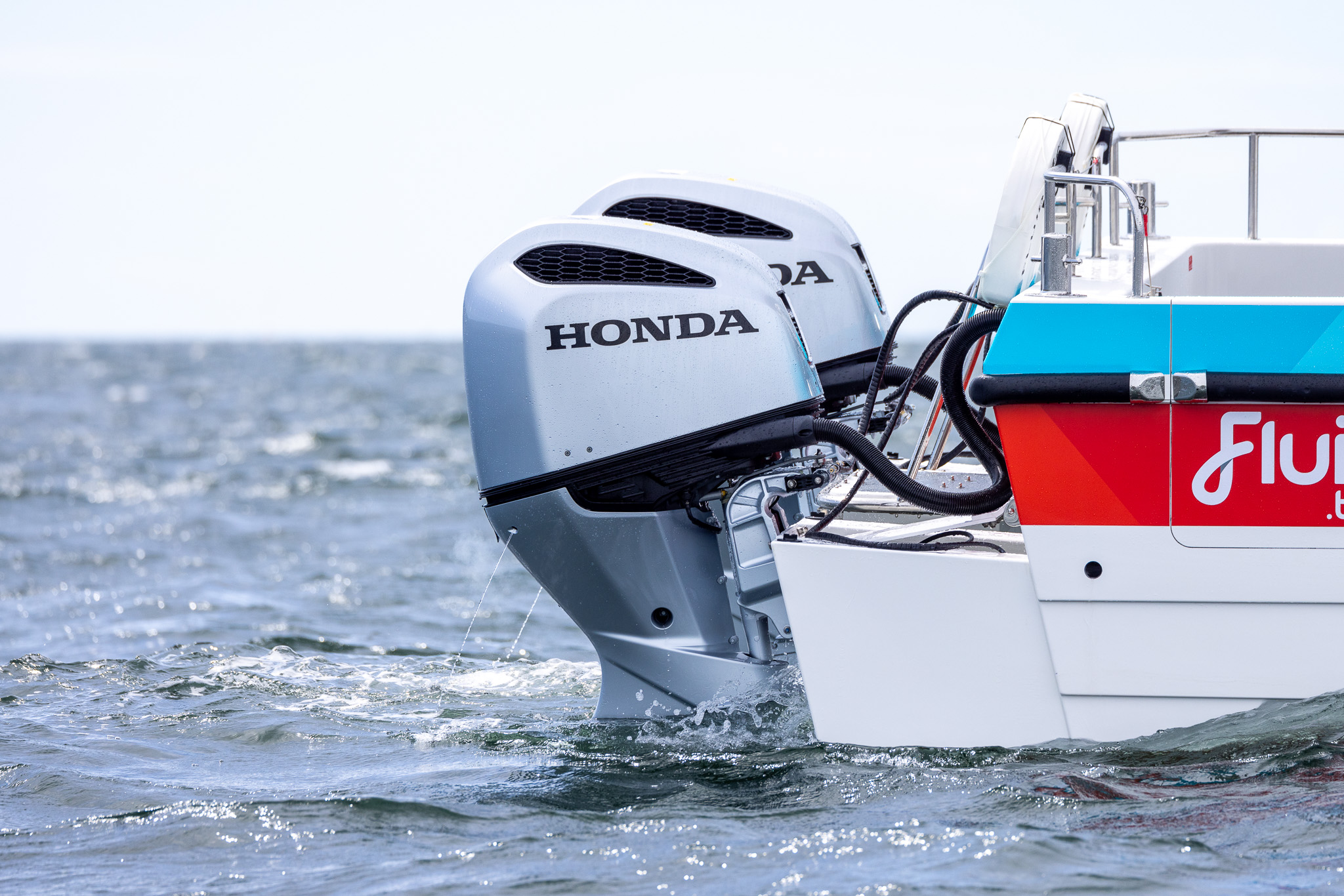
Key Considerations for Installing Hydraulic Porta Jacks on a Cheetah Catamaran
The decision to fit hydraulic Porta Jacks to a Cheetah catamaran involves more than simply increasing usable deck space. While removing conventional engine wells can recover almost a metre of working deck length, there are several important technical considerations that influence whether Porta Jacks are the right solution for a particular vessel.
At Cheetah Marine, engine positioning is considered as part of the overall hull design, taking into account weight distribution, hydrodynamic performance, structural loading and the vessel’s intended operating conditions. Some of those design and engineering considerations are explained below.
⟶ Centre of Gravity and Vessel Balance
Moving the outboard engines approximately 660mm (26 inches) aft of the transom has a measurable effect on the vessel’s longitudinal centre of gravity (LCG).
During the design process, Cheetah calculates the vessel’s centre of gravity using the weight and position of its principal components, including engines, fuel, batteries, structure and equipment. Each component contributes a moment based on its weight multiplied by its distance from a reference point.
For example, on a typical 11.2 m Cheetah with twin 350 kg outboards and a displacement of approximately 5,500 kg, moving both engines 660mm mm aft would shift the overall LCG by approximately 98mm, before accounting for the weight of the Porta Jacks and any associated structural changes.
Although relatively small, this movement can influence stern immersion, acceleration, running trim and fuel efficiency. An aft centre of gravity is not necessarily undesirable, but it must be considered alongside the hull’s running characteristics and expected loading conditions.
⟶ Water Flow and Propeller Performance
The relationship between engine position and water flow is particularly interesting on a power catamaran. As water passes along the hulls, it is influenced by their geometry, running attitude and the interaction between the inner hull surfaces and the tunnel. The flow immediately behind the transom can contain turbulence, aerated water and variations in local water-surface height.
Moving the propellers farther aft changes where they operate within this flow. In some circumstances, additional setback can position the propellers in cleaner, more consistent water as the disturbed flow leaving the hull has had some opportunity to reorganise. This can improve propeller grip and reduce ventilation.
However, this is not guaranteed. The wake continues to evolve behind the vessel, and depending on hull geometry, speed and trim, the propellers may encounter a lower local water surface or a more aerated region farther aft.
There is also a relationship between setback and engine mounting height. The water surface immediately behind a moving hull is not necessarily level with the surrounding water, meaning the optimum propeller depth can change as the engine is moved aft.
On Cheetah’s asymmetric catamaran hulls, these effects must be considered in relation to the individual hull wakes and the tunnel flow. Consequently, engine setback and vertical adjustment should be evaluated together rather than independently.
⟶ Engine Lowering and Propeller Grip
One of the practical advantages of Porta Jacks is the ability to lower the engines below their normal running position.
In rough seas, particularly when the stern rises and falls through waves, propellers can encounter aerated water or become insufficiently immersed. This can result in ventilation and a temporary loss of thrust.
Lowering the engines by a couple of inches can increase propeller immersion, helping maintain more consistent grip and thrust.
This can also be valuable during low-speed marina manoeuvring, when reliable propeller response is more important than minimising drag.
The compromise is that lowering the engines increases the submerged area of the gearcases, potentially increasing resistance. The most effective engine height therefore depends on the operating conditions.
⟶ Shallow-Water Operation
Porta Jacks also allow the engines to be raised vertically without changing their trim angle. With conventional outboard installations, gaining additional propeller clearance requires trimming the engines upwards, which changes the direction of thrust and can reduce manoeuvring effectiveness.
By raising the engines vertically, the propeller shaft angle can remain unchanged, keeping thrust directed more effectively astern while reducing the draught of the propulsion system.
This is particularly useful for vessels operating in shallow coastal waters, estuaries and drying harbours.
The maximum practical lift remains dependent on maintaining adequate propeller immersion and cooling-water supply.
⟶ Structural Design and Transom Loading
Positioning the engines approximately 660 mm aft of the transom increases the bending moment imposed on the supporting structure.
For twin 350 kg outboards, this represents an additional static moment of approximately 6.1 kN·m compared with the same engines mounted directly at the transom, before accounting for dynamic loads and the weight of the jacks themselves.
Cheetah’s transoms are engineered with substantial structural capacity, exceeding the applicable requirements of ISO 12215-7 by a considerable margin.
Nevertheless, fitting Porta Jacks requires consideration of the complete load path, including the mounting brackets, fasteners, local reinforcement and the transfer of engine thrust and dynamic loads into the hull structure.
The strength of the transom alone does not determine the suitability of the installation; the complete assembly must be considered.
The Right Installation for the Right Vessel

Every Cheetah catamaran is built around the individual requirements of its owner, with the intended use of the vessel at the heart of the process. While customer preferences and operational needs drive the specification, our role is to apply our engineering knowledge and experience to evaluate the options, explain the technical considerations and recommend the most appropriate solutions.
Our Trusted Supplier – Porta Products
Through this collaborative approach, we ensure that performance, efficiency, safety and practicality are carefully balanced, delivering a vessel that not only meets the customer’s expectations but is engineered to excel in its intended role.
We’re proud to work with Porta Products as a trusted supplier of Porta Jacks, helping us deliver practical, reliable solutions for our customers.
Find out more about their products at portaproducts.com.
Thank you to the Porta Products team for their continued support!

Cheetah Marine Team